The Decans
Capricorn · Second Face
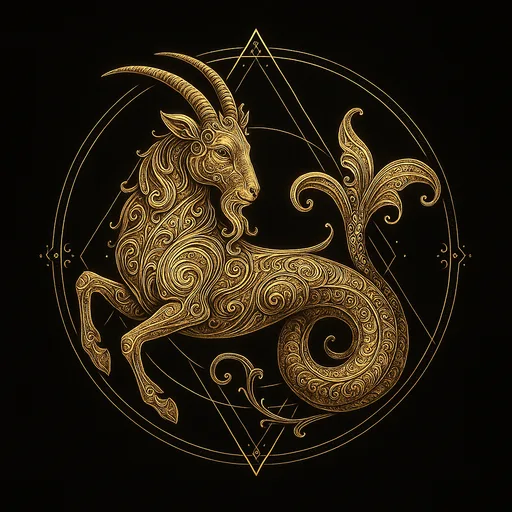 Capricorn · Second Face
Capricorn decan 2 · sub-ruled by Mars
The second face of Capricorn — the ten degrees from 10° to 20°, carrying Mars as their Chaldean sub-ruler.
Mars fuels Capricorn with drive: relentless effort, the will to push past every wall. Its ambition is fierce; its work is to rest as well as to reach.
The Second Face of the Goat
In the ancient Chaldean order of planetary rulership, each zodiac sign divides into three faces or decans—ten-degree intervals, each carrying its own planetary signature. The second face of Capricorn spans from 10° to 20° and bears the rulership of Mars, that fierce planet of will, effort, and hunger. Where the first face of Capricorn (0°–10°) carries Saturn's heavy gravity—the weight of time and structure—the second face ignites with Martian force. Mars here does not soften Capricorn's discipline; rather, it sharpens it into a blade. The ambition becomes less patient, the work more urgent, the drive more nakedly visible. This is Capricorn not merely enduring but pushing, not accepting limitation but testing it, again and again, until it yields.
The Will Behind the Wall
Where Saturn builds slowly upward, Mars in Capricorn's second face builds *through*—through obstacles, exhaustion, doubt. There is a ferocity here that can seem at odds with Capricorn's cool reputation, yet it is perfectly consistent: Mars does not rebel against structure, but harnesses it for conquest. This decan speaks to the person driven by more than duty—by a genuine hunger to master, to prove, to exceed. It recognizes ambition not as a vice but as a fuel. Yet there lies a shadow in this pairing: Martian intensity can push the Capricorn body and spirit beyond what they can sustainably bear. The second face of Capricorn must learn that rest is not failure, that stopping is not weakness, that the fiercest victories are sometimes won by knowing when to withdraw and recover.
Mars Among the Ancient Goatherds
The planetary faces appear in the foundational texts of Arabic and medieval astrology, particularly in works attributed to the 8th-century astrologer Al-Qabisi and preserved through the Renaissance masters. Mars, in traditional astrology, governed not only war but craft, skill, and the sharp focus required to carve anything of value from raw matter. In mythology, Mars was not only the god of battle but of smithwork—the forge, the hammer, the transformation of base metal into weapon or tool. When Mars rules a Capricorn decan, this smithing quality becomes central: the capacity to work metal, stone, and will into something enduring. The goat itself, Capricorn's symbol, was an animal of the mountain—hardy, sure-footed, climbing where others could not. Mars here gives that climb teeth.
A Question for Reflection
If you find yourself under this decan's influence—whether by birth or by the turning of the heavens—consider: Where in your life are you pushing hardest, and at what cost? Is your drive nourishing your ambitions, or burning away the ground beneath you? Mars in Capricorn's second face invites you not to abandon your hunger, but to befriend it—to ask whether your relentless effort is building something that will endure, or consuming itself. The real test is not whether you can reach the summit, but whether you will remain whole when you do.
Want to know what Capricorn · Second Face means in your chart? The Eye reads it through your own birth sky.
Open your reading →