The Chinese Zodiac
Monkey
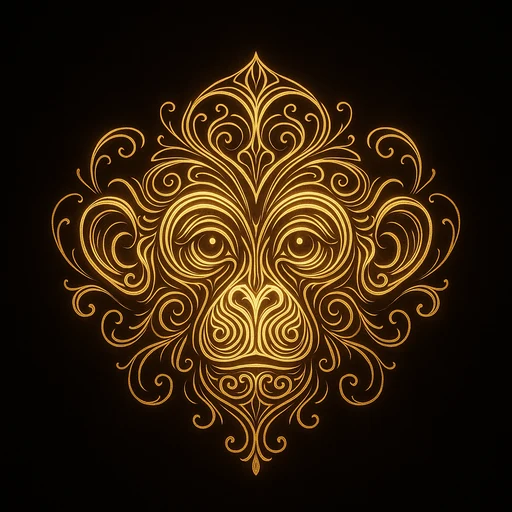 Monkey
Chinese zodiac · 9th sign · Yang Metal
The ninth sign of the Chinese zodiac, the clever and inventive one.
The Monkey is cleverness and invention: playfulness, curiosity, and a mind that solves what others cannot. It delights in the new; its growth is to see a thing through past the point where it stops being fun.
The Ninth Sign
The Monkey is the ninth creature in the Chinese zodiac's twelve-year cycle, a position it has held for millennia in the lunar calendar. Born in years such as 1908, 1920, 1932, 1944, 1956, 1968, 1980, 1992, 2004, and 2016, those marked by the Monkey are said to inherit its defining qualities: alertness, agility, and an appetite for novelty. In the elemental system, each zodiac sign cycles through five elements—Wood, Fire, Earth, Metal, and Water—over sixty years. The Monkey born under Yang Metal (most recently 1920 and 1980) is thought to possess particular sharpness and determination, a metallic edge to its natural wit.
The Monkey's place in the zodiac arose from ancient Chinese cosmology and the folk tale of the Great Race, in which the Jade Emperor summoned all creatures to cross a river; the clever Monkey arrived ninth by riding on the raft of the Ox and then leaping ahead at the final moment—a story that captures perfectly the sign's reputation for cunning and opportunism.
Character and Significance
In classical Chinese thought, the Monkey embodies yang energy—active, expansive, restless. It is the sign of quick intellect and improvisation, of the mind that perceives patterns others miss and finds solutions in unexpected places. The Monkey is drawn to puzzles, games, and intellectual challenge; it thrives on variety and abhors tedium. In love and friendship, Monkeys are witty and engaging, though they can tire of constancy and crave stimulation.
Yet the Monkey has long carried shadow alongside light. Traditional astrology notes its propensity for mischief, superficiality, and inconsistency—the tendency to flit from one interest to another without depth. In Daoist and Buddhist texts, the restless monkey mind became a metaphor for the untrained human consciousness, jumping from thought to thought like a creature swinging through trees, never still enough to see clearly.
In Myth and History
The Monkey appears throughout Chinese literature and art not as mere zodiac symbol but as character and archetype. In the Ming Dynasty novel Journey to the West, the Monkey King Sun Wukong is the hero—powerful, clever, and ultimately disciplined through wisdom. He represents the untamed intellect made noble through learning and virtue.
In classical ink painting, the monkey is a favorite subject: playful, agile, caught in moments of curiosity or mischief. These depictions honor both the creature's wit and its humility; a monkey remains dependent on its environment and must adapt to survive.
The Monkey also appears in the Five Animals of martial tradition (alongside Crane, Tiger, Leopard, and Snake), representing evasiveness, adaptability, and deceptive speed.
A Mirror for Reflection
If Monkey appears in your chart or speaks to you, consider: Where does your cleverness serve you, and where does it become a way to avoid depth? What have you begun with great enthusiasm but left unfinished when the novelty faded? The Monkey invites you not to suppress your curiosity and wit, but to ask whether there is something worth pursuing all the way through—not because it is easy, but because it matters. Is there a puzzle in your life that requires not just quick thinking but patient attention?
Want to know what Monkey means in your chart? The Eye reads it through your own birth sky.
Open your reading →