The Major Arcana
Death
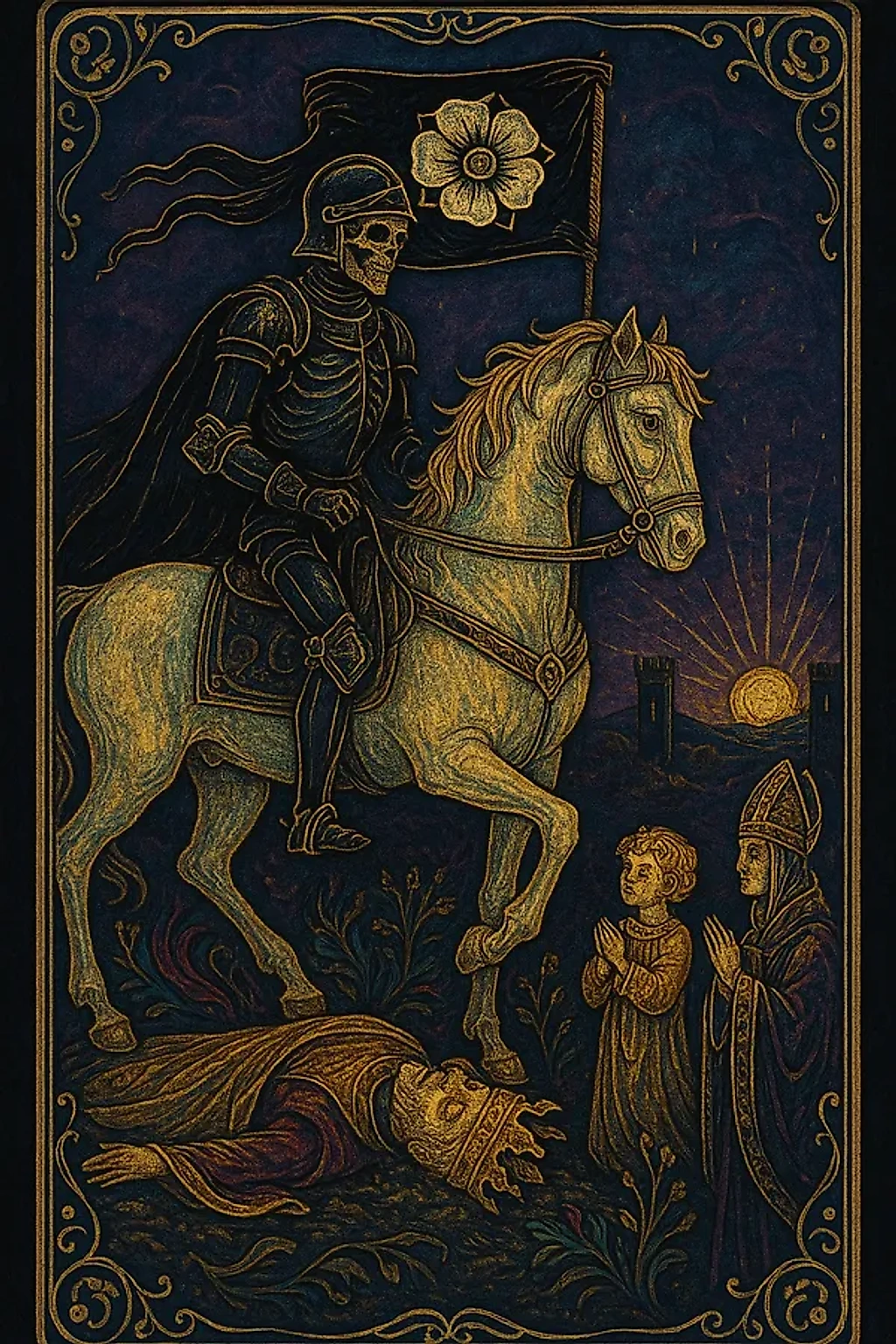 Death
Major Arcana 13 · endings · transformation · renewal
The 13th card of the Major Arcana — endings, transformation, renewal.
Not a literal death, but transformation. Death is the clean ending that clears the ground — release what has run its course so something new can be born.
The Card
Death is the thirteenth card of the Major Arcana, numbered with the digit that Western superstition has long feared. In the most recognizable depiction—the Rider-Waite tradition, illustrated by Pamela Colman Smith in 1909—a skeletal figure in armor rides a pale horse across a barren landscape, carrying a black flag marked with a white rose. The rose, ancient symbol of life and beauty, persists even in death's presence. Below the horse, figures kneel or fall in surrender: a king, a mother, a child, a bishop. The sun sets behind them, yet a new dawn breaks on the horizon.
This is not the grim reaper of folk tradition, but a more complex herald. The card emerged in fifteenth-century Italian tarot decks, originally called La Morte, where it carried similar weight and ambiguity. What distinguishes Death from lesser cards of difficulty is its absoluteness: it speaks not of struggle or obstacle, but of threshold—the point at which one state ends and another must begin.
The Transformation
To meet Death in a reading is to encounter the principle of necessary ending. It does not promise pain or loss alone, but the inevitability of change itself. A chapter closes. A belief falls away. A relationship transforms into something unrecognizable, or ceases entirely. The old order cannot hold.
Yet Death arrives not as punishment but as the gardener's knife: what is pruned makes room for growth. The card speaks to anyone standing at a real threshold—the end of employment, a severed friendship, the dissolution of an identity that no longer fits. It asks: what must be released? What have you already outgrown? The white rose on Death's banner suggests that beauty and meaning persist even through the ending; the new dawn at the horizon promises that transformation is not mere destruction, but renewal.
Through the Ages
The tarot Death card has carried its ambiguity since its inception. Medieval and Renaissance Italian culture understood Death as both terror and relief—the end of suffering, the great equalizer before which king and peasant stood level. The Danse Macabre, a late-medieval artistic tradition, portrayed skeletal Death leading all ranks of people toward the tomb, a visual language the emerging tarot inherited and reinterpreted.
By the nineteenth century, as tarot moved from game to divination, Death became the card that most unnerved querents—yet serious practitioners insisted on its deeper reading. It was never, in authentic tradition, a prediction of literal death, but a marking of life's passages. Modern psychology would recognize in it the concept of ego death, the necessary dissolution of false selves that allows authentic becoming.
As Mirror
When Death appears in your own reflection, ask not what you fear losing, but what you are ready to release. What identity, belief, or pattern has served you, but no longer fits? What ending have you been resisting, that might open a door if you stopped struggling against it?
The card does not ask you to invite destruction, but to notice where you are already changing—where life itself is asking you to let go. It is an invitation to trust the process of becoming, to understand that nothing solid need crumble for transformation to occur, only the illusion of permanence. What season of your life is turning?
Want to know what Death means in your chart? The Eye reads it through your own birth sky.
Open your reading →