The Major Arcana
Wheel of Fortune
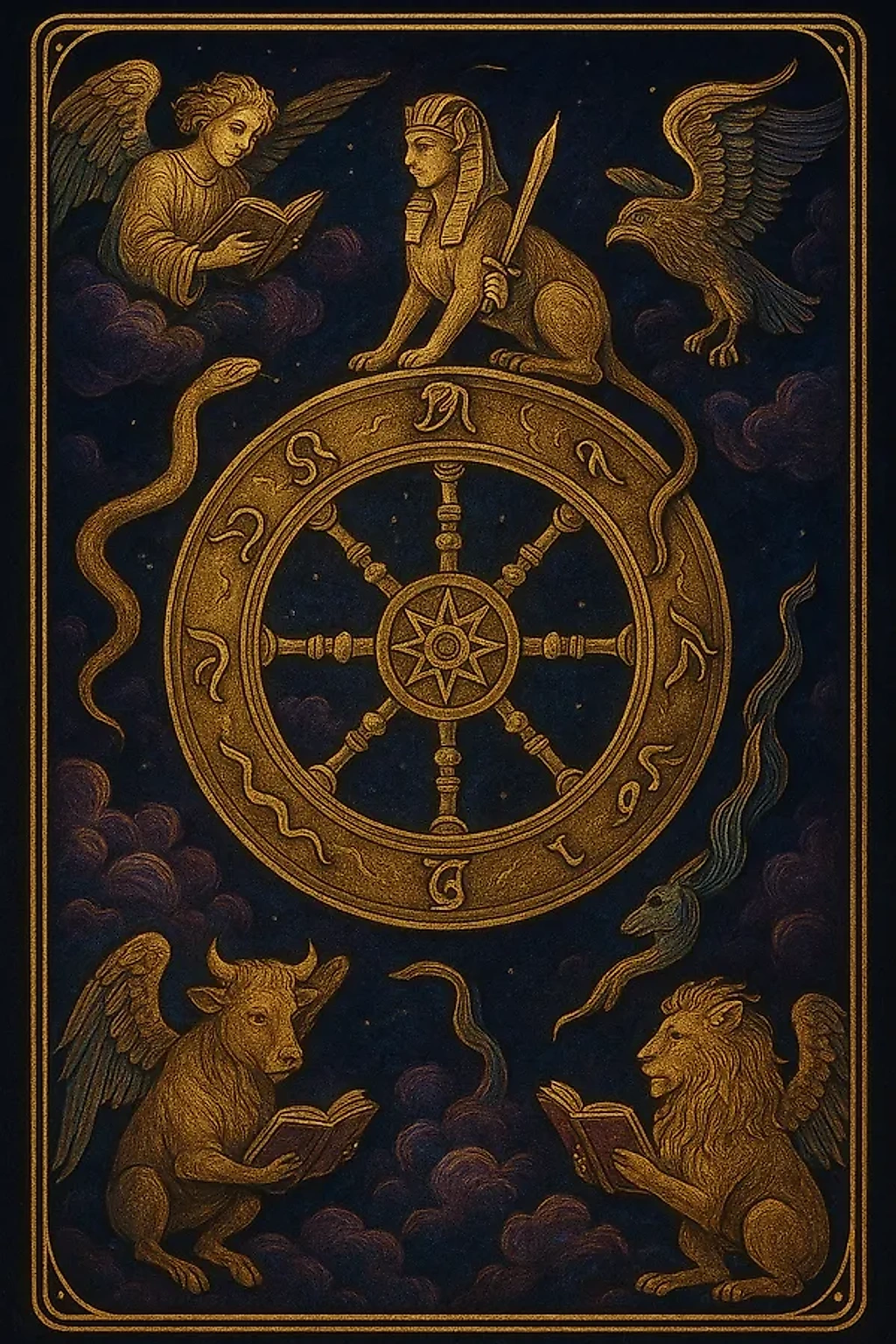 Wheel of Fortune
Major Arcana 10 · cycles · fate · turning points
The 10th card of the Major Arcana — cycles, fate, turning points.
The turn of fortune's wheel. Cycles rise and fall beyond your control — a turning point, a shift of luck, and the invitation to move with the turning rather than against it.
The Card Itself
The Wheel of Fortune is the tenth card of the Major Arcana, a threshold card that marks a turning point in the sequence of the fool's journey. It depicts a wheel set in motion, often surrounded by symbols of the zodiac or the four fixed signs of the zodiacal cross. In classical Rider-Waite imagery, a wheel turns while figures rise and fall around it—some ascending, others descending—suggesting the ceaseless rotation of circumstance. A sphinx or crowned figure often sits at the apex, representing consciousness or will observing the mechanical turn below. The wheel itself has no moral character; it turns by its own law, indifferent to hope or fear.
The card appears across many European tarot traditions from the fifteenth century onward, and its archetypal image—fortune's wheel—reaches back through medieval Christianity, classical philosophy, and ancient astrology. It is fundamentally a card about cyclical time, not linear progression.
Fortune's Law
Where other cards address choice, desire, or consequence, the Wheel speaks to the order beyond human will—the great rhythms that move through all things. Seasons turn, tides rise and fall, empires ascend and crumble. The card invites humility not through shame but through recognition: what rises must descend, and what has descended may rise again. This is neither pessimism nor blind optimism, but a sober truth that frees us from the illusion of permanent control.
It speaks especially to those caught in a turning—a loss that seems absolute, or a fortune too sudden to trust. The Wheel reminds us that we stand on a circle, not a line; that stillness in the center is possible even while the rim revolves.
The Mirror Within
When you meet this card in reflection, ask: Where in my life do I resist the turning? Where do I cling to what cannot stay, or refuse to step into what wishes to arrive? The Wheel does not ask you to be passive—only to distinguish between struggle and surrender, between the will that acts and the will that releases.
Notice what you cannot change, and notice too the small freedoms that open when you stop fighting the shape of things. The invitation is not fatalism but a kind of grace: to move with the turning rather than against it, and to find your steadiness not in unchanging circumstance, but in the center—the still point around which all wheels turn.
Want to know what Wheel of Fortune means in your chart? The Eye reads it through your own birth sky.
Open your reading →