The Major Arcana
The Hierophant
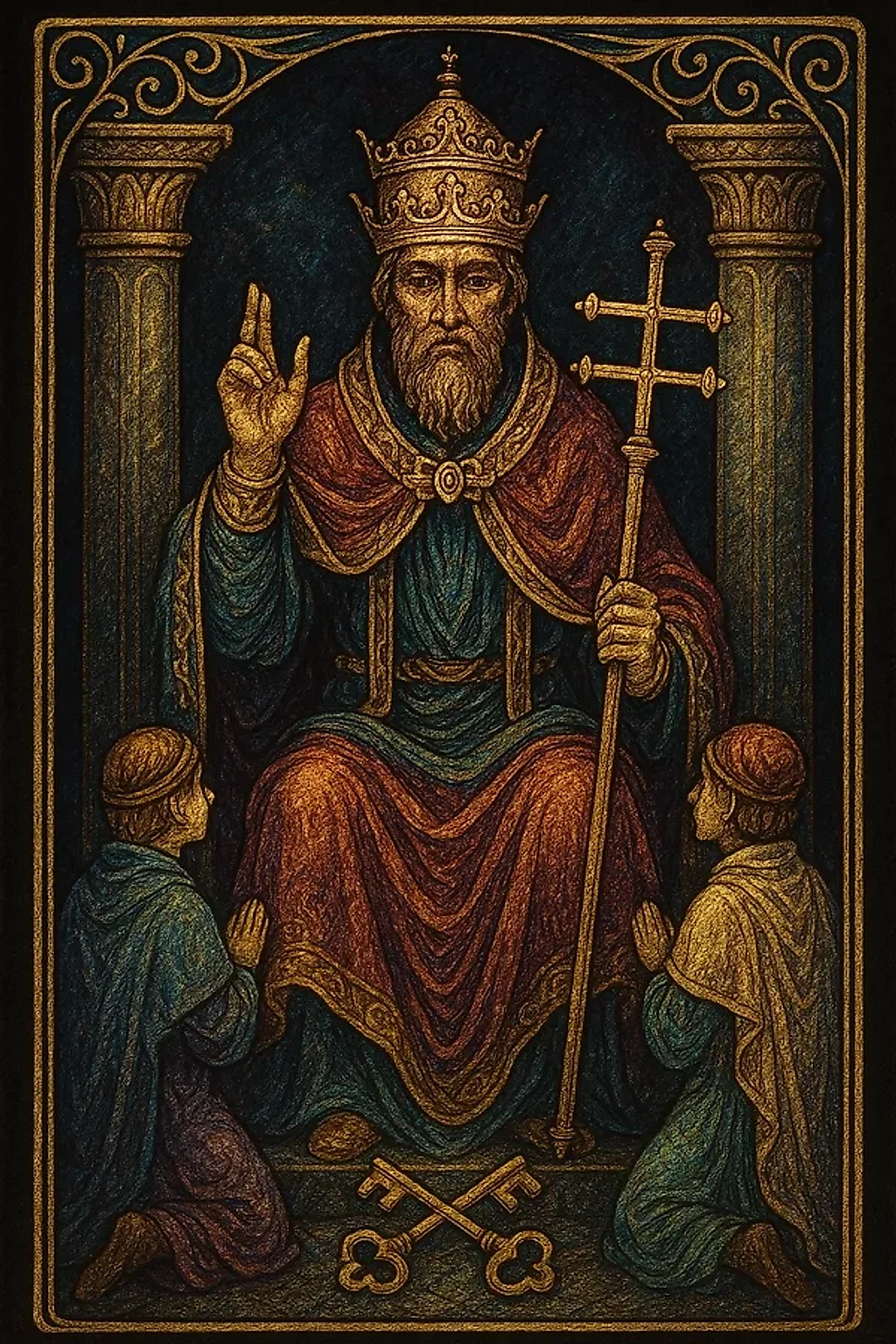 The Hierophant
Major Arcana 5 · tradition · guidance · belonging
The 5th card of the Major Arcana — tradition, guidance, belonging.
The keeper of shared meaning. The Hierophant is teaching, tradition, and the wisdom held by a lineage — learning the established way, or finding your place within something larger.
The Card Itself
The Hierophant is the fifth card of the Major Arcana, arriving after the Emperor and before the Lovers. In most classical decks—the Rider-Waite, the Visconti, the Marseille tradition—he appears as a robed and crowned religious authority, often seated between two pillars, holding a staff or scepter. His figure echoes the Pope or High Priest of antiquity: a keeper of sacred knowledge, a mediator between the earthly and the divine. The number 5 carries the energy of communication and learning; the Hierophant speaks, teaches, and transmits. Unlike the Magician's solitary power, or the High Priestess's hidden wisdom, the Hierophant's knowledge belongs to a community—a church, a school, a lineage, a tradition passed from hand to hand across generations.
Iconographically, he often wears vestments in red and gold, colors of both passion and illumination. His throne is solid; his posture is formal and dignified. This is not spontaneity or rebellion, but the weight of continuity, the gravity of responsibility.
The Meaning It Carries
The Hierophant speaks to the human need for structure, belonging, and shared meaning. He is the voice of "the way things are done"—ritual, orthodoxy, established practice. In a reading, he may appear when you are learning from a teacher, following a path, or finding your place within a larger tradition: a religion, a craft, a family lineage, or a culture.
Yet he is not mere rigidity. The greatest hierophants—priests, teachers, keepers of lore—understand that tradition lives only when it is transmitted with care and sincerity. He represents both the rules and the wisdom behind them. He asks: what do you inherit? What do you respect? Where do you belong? The card can speak to blessing and initiation, to the comfort of knowing where one fits, but also to the question of whether the tradition you follow still speaks truth to you, or whether it has calcified into empty form.
Across Time and Cultures
The Hierophant's roots run deep. The tarot itself was born in Renaissance Italy, where the card was called the Papa or Papessa—reflecting the overwhelming spiritual authority of the Church in that world. But the archetype is far older: every culture holds figures who serve as keepers of sacred knowledge—the shaman, the elder, the ordained priest, the keeper of stories. In Jewish tradition, the High Priest wore the breastplate of the Urim and Thummim, bearing the names of the twelve tribes. In ancient Egypt, the priest of Thoth held the secrets of writing and magic. The Hierophant is universal because the need for guidance, initiation, and belonging is universal.
In the tarot's evolution, the Hierophant has never lost his essential character. Whether called Pope, Priest, or Hierophant, he remains the voice of established wisdom—sometimes trustworthy, sometimes corrupted, always influential.
As a Mirror
When this card appears in reflection, ask yourself: what tradition or lineage are you part of? Do you teach or learn? Is there a teacher, mentor, or elder guiding your way? And more intimately: do you trust the structures that hold you, or are you beginning to question them? The Hierophant invites you to consider whether you are honoring wisdom that deserves your respect, or whether you might be outgrowing a form that no longer fits your soul. There is no single answer; the card is a mirror, not a map. It may show you the blessing of belonging, or the weight of expectation. It may whisper that it is time to seek a new teacher, or that you yourself are ready to become one.
Want to know what The Hierophant means in your chart? The Eye reads it through your own birth sky.
Open your reading →