The Major Arcana
The Emperor
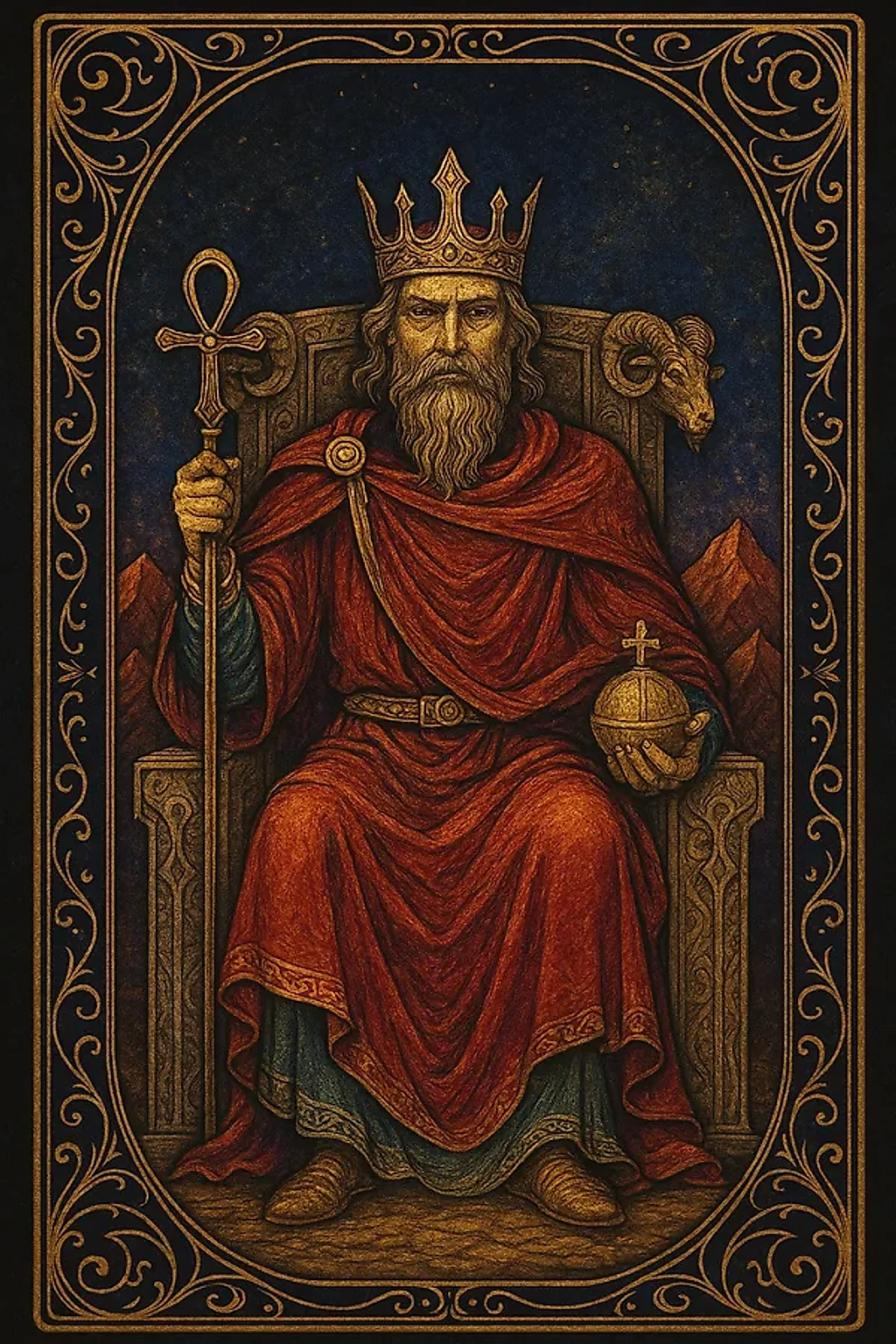 The Emperor
Major Arcana 4 · structure · authority · stability
The 4th card of the Major Arcana — structure, authority, stability.
Order and steady authority. The Emperor builds the structure that keeps things standing — leadership, discipline, and the security of a firm foundation.
The Card Itself
The Emperor is the fourth card of the Major Arcana, following the Empress. In most classical decks, he sits enthroned—often crowned, sometimes holding scepter and orb, the emblems of sovereignty. His throne is typically of stone or iron, suggesting permanence rather than comfort. He faces forward, steady and unmoving, his gaze direct. The number four itself carries weight: four corners of the earth, four pillars, the stability of a square. Where the Empress represents fertility and flow, the Emperor embodies the masculine principle of boundary, rule, and lasting form. He is structure made flesh.
The Principle of Order
The Emperor speaks to the human need for framework—the laws, hierarchies, and institutions that allow a society to cohere and endure. He is not tyranny, but rather the archetype of legitimate authority: the father who sets limits, the builder who raises walls, the leader who takes responsibility for what he oversees. In the inner life, he represents our capacity for self-mastery, discipline, and the setting of clear intention. To invoke the Emperor is to ask: what structures do I need? What boundaries serve me? What am I willing to hold steady, even when holding steady is difficult?
Across Time and Tradition
The Emperor appears in the oldest tarot sequences—the Visconti decks of fifteenth-century Milan show him crowned and sceptered, a figure of obvious power. Medieval and Renaissance courts understood him as the earthly counterpart to divine order; his authority was seen as reflecting God's governance of creation. In classical symbolism, he has been linked to Mars (the god of will and force), to Saturn (discipline and time), and to the alchemical principle of salt—that which preserves and gives form. Across cultures and centuries, the image recurs: the pharaoh, the emperor, the king—the one who maintains the edifice.
The Emperor in Reflection
When the Emperor appears in your contemplation, ask yourself: Where am I being called to take authority—not over others, but over my own direction? What rules have I internalized, and do they still serve? Do I build with stone or sand? Can I stand firm without becoming rigid, lead without dominating? The Emperor is also an invitation to examine the structures around you: family, work, society. Are they just? Do they hold? And where do you belong within them? This card is a mirror not of power itself, but of the question: what do I wish to establish that will outlast me?
Want to know what The Emperor means in your chart? The Eye reads it through your own birth sky.
Open your reading →