The Major Arcana
The Moon
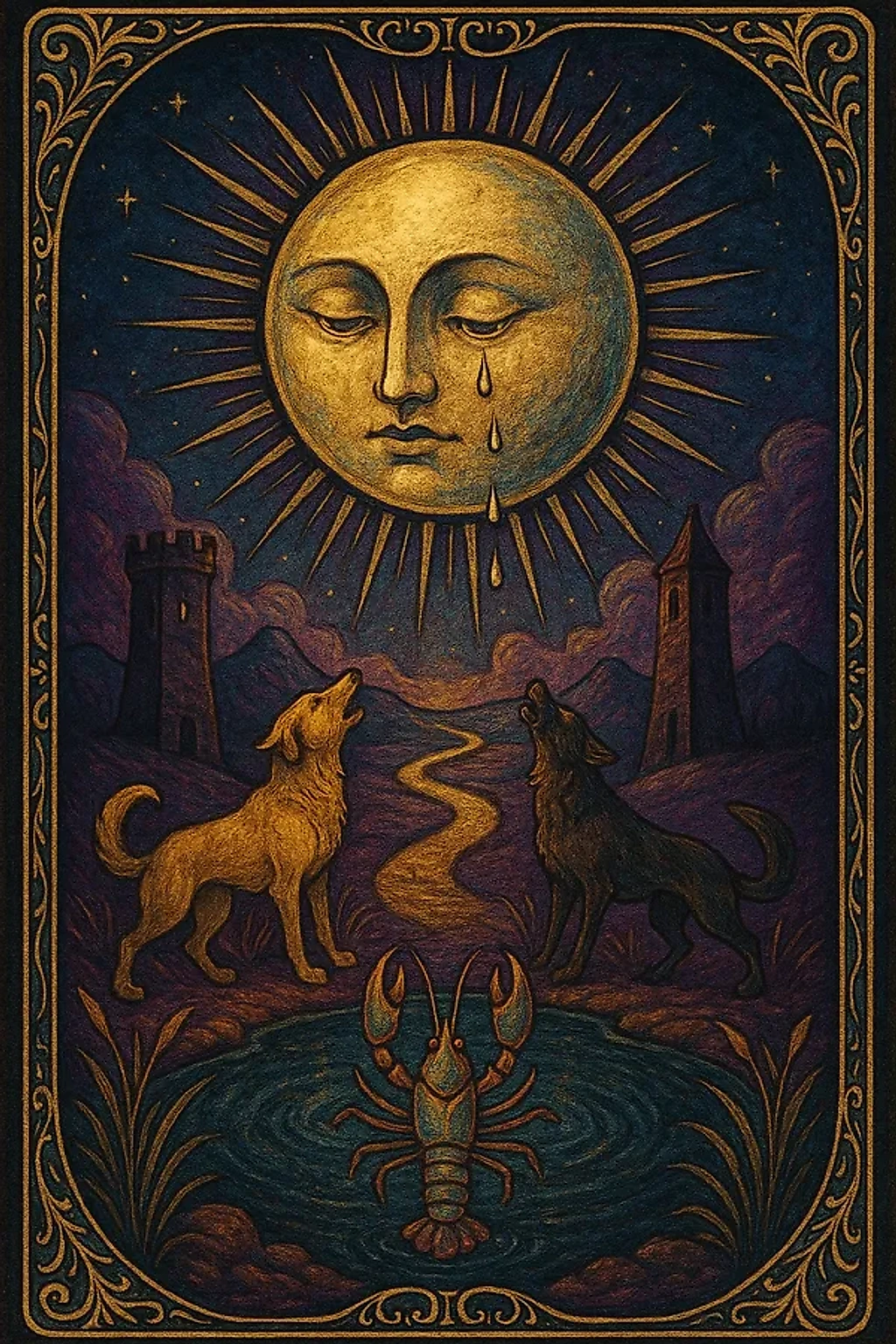 The Moon
Major Arcana 18 · intuition · illusion · the unknown
The 18th card of the Major Arcana — intuition, illusion, the unknown.
The road by moonlight. The Moon is dream, instinct, and things not yet clear — trust your intuition through the uncertainty, and don't mistake shadows for the whole truth.
The Card and Its Place
The Moon is the eighteenth card of the Major Arcana, the penultimate step before The Sun and The World complete the Fool's journey. It first appeared in Italian tarot decks of the fifteenth century, where it depicted a moon face gazing down upon two towers, a dog, a wolf, and a path winding toward water — all rendered with the careful symbolism of Renaissance engravers. The card's number, 18, carries its own resonance: in Western numerology, 1 and 8 sum to 9, the number of completion and mystery alike. In traditional tarot imagery, the Moon itself is often shown in its crescent or full form, sometimes with a face, presiding over a landscape caught between day and night. Below it, the world remains half-visible, rendered in shadow and uncertain light.
The Territory of the Unseen
The Moon rules the realm of intuition, the subconscious, dreams, and all that lies beneath the surface of rational sight. It speaks to illusion not as falsehood, but as the mind's natural work — the way we project meaning onto shadows, the way fear can magnify a small concern into something monstrous. This is the card of psychological depth, of emotions that move like tides, of the body's wisdom speaking in a language the waking mind does not yet comprehend. It is also the card of secrets, mysteries not yet revealed, and the fertile uncertainty from which all creation emerges. Where The Sun brings clarity and direct knowing, The Moon asks us to sit with ambiguity, to trust what cannot yet be named or proven. It speaks to artists, healers, and anyone who works with the invisible currents beneath ordinary life.
Moon-Light Across Time
The Moon has held dominion over night, dreams, and hidden knowledge since the beginning of human mythology. The ancient Sumerians tracked her cycles for farming and ritual. The Greeks knew her as Selene, Hecate, and Diana — the maiden, the crossroads guardian, the wild huntress. Medieval alchemists called the Moon the symbol of silver and the feminine principle, the reflection of the Sun's gold light. In astrology, the Moon governs the emotional body, memory, and the tides of the psyche. The Tarot inherited all of this — not as superstition, but as a recognition that certain symbols speak to truths the rational mind alone cannot grasp. The Moon card carries forward an ancient trust in intuition, in the knowledge held by dreams, in the necessity of darkness for growth.
A Mirror for the Present
When The Moon appears in your reflection, ask yourself: What am I not yet seeing clearly? What truth is present, but still veiled? The invitation is not to fear the unknown, but to develop your sensitivity to it. Where in your life are you being called to trust your instinct over certainty? What shadows have you projected meaning onto — and what might they reveal, if you look closer? The Moon asks you to honor your dreams and intuitions as legitimate guides, not as whimsies to be dismissed. It also gently cautions: do not mistake every fear for wisdom, nor every feeling for fact. Walk by moonlight, not as the only truth, but as the light available now — and wait for fuller illumination when it comes.
Want to know what The Moon means in your chart? The Eye reads it through your own birth sky.
Open your reading →