The Major Arcana
The Star
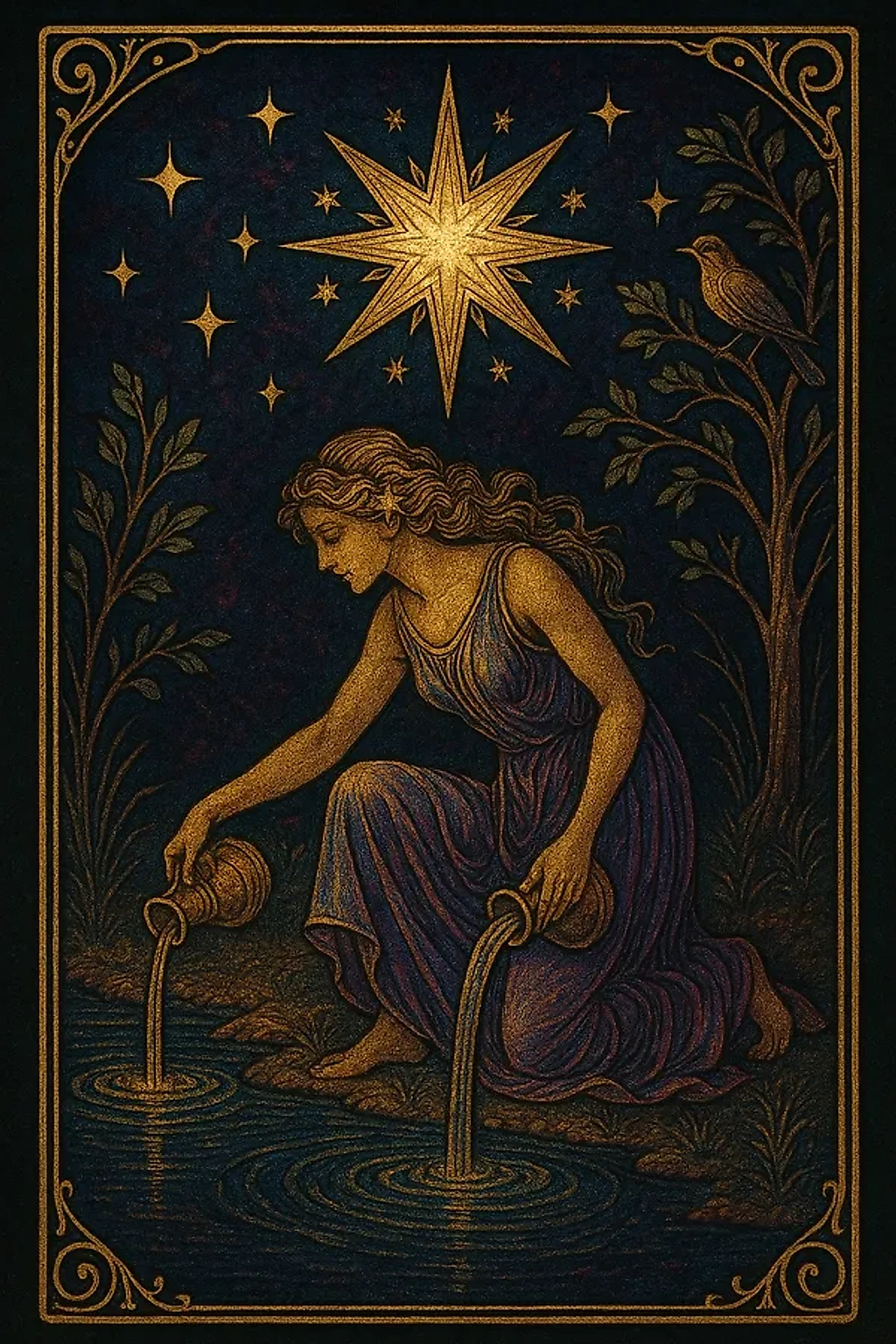 The Star
Major Arcana 17 · hope · healing · renewal
The 17th card of the Major Arcana — hope, healing, renewal.
Calm after the storm. The Star is hope and quiet healing — faith renewed, inspiration returning, and the sense that you are gently guided again.
The Card Itself
The Star is the seventeenth card of the Major Arcana, arriving in the sequence after the Tower's devastation and before the Moon's uncertainty. In most traditional decks—the Rider-Waite-Smith interpretation being the most recognized—a naked woman kneels by a pool of water beneath a large, luminous star surrounded by seven smaller stars. She pours water into the pool and onto the earth, an act both practical and devotional. The figure is often depicted in a posture of openness and trust, her gaze lifted toward the celestial sphere. The star itself is eight-pointed, a geometry that in Western esoteric tradition represents the meeting of the material and spiritual worlds. Water, earth, and sky converge in this image—the essential elements of renewal.
The Significance of Hope and Guidance
The Star speaks to the restoration of faith after loss or confusion. It is not the triumph of the Sun, which follows it in the sequence, but rather the first gentle light in darkness—the North Star by which travelers have always oriented themselves. Psychologically, the card addresses the human need for direction and meaning, the inner compass that realigns itself after trauma or doubt. The woman's nakedness suggests vulnerability, yes, but also authenticity and absence of pretense. She has nothing left to hide because the illusions have already fallen away. What remains is sincere connection to something larger than herself. In spiritual and philosophical contexts, the Star has long represented the soul's aspiration, the longing to be guided by something true and unchanging amidst the flux of earthly life.
Ancient Roots and Enduring Symbols
The veneration of stars as guides and omens reaches back into human prehistory. The Magi followed a star in Christian tradition; Greek navigators and poets invoked Polaris as divine; in Hermetic philosophy, the stars were understood as intermediaries between the eternal and the temporal. When the Tarot emerged in fifteenth-century Italy as a card game before becoming a tool of divination, it inherited these deep currents of star-symbolism. Astrologers and mystics recognized in the Star card an echo of Aquarius, the water-bearer—the same figure sometimes depicted in the card itself. Aquarius in classical astrology ruled humanitarian ideals, cosmic consciousness, and the renewal of vision. The card thus carries within it centuries of human contemplation about guidance, hope, and the relationship between the soul and the infinite.
Reading the Star Within Yourself
When the Star appears as a mirror for reflection, consider: What small light have you begun to trust again? Where in your life are you being asked to pour your gifts into the world, even when you are uncertain? The Star invites you not to predict clarity, but to notice it—to recognize those moments when faith returns quietly, when you sense yourself gently held by something benevolent. It may ask whether you have permission to hope, or whether you are withholding that permission from yourself. There is no demand here, only an opening: a reminder that healing is often less dramatic than we expect, arriving not as a thunderbolt but as the steady presence of a distant, reliable light.
Want to know what The Star means in your chart? The Eye reads it through your own birth sky.
Open your reading →